Why I Chose AI
There was a time when I thought I'd spend my entire career as a web developer.
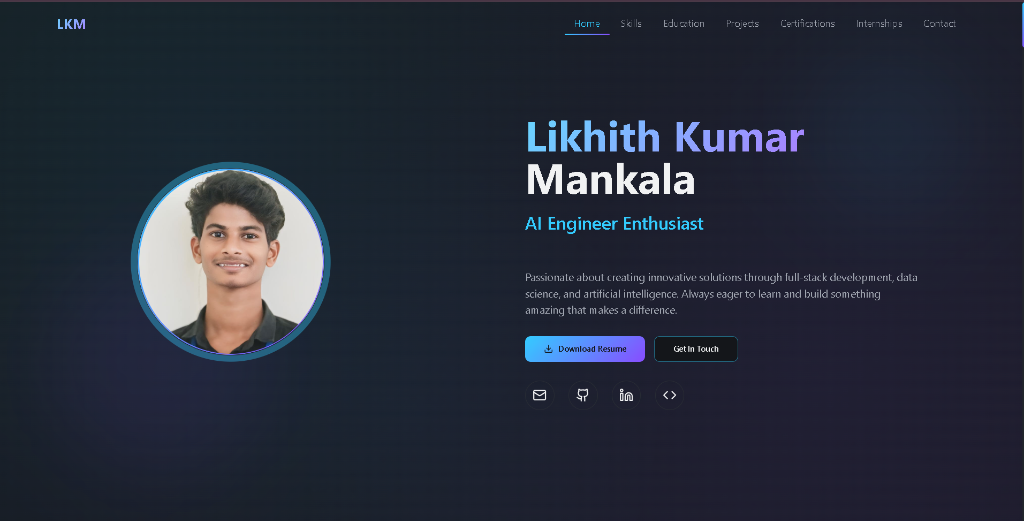
When I first started learning software development, my world revolved around HTML, CSS, JavaScript, React, and Next.js. Every new project made me a little more confident, and every completed website felt like a small achievement. I enjoyed building interfaces, connecting APIs, and watching ideas come to life in the browser.
At that point, I believed web development was where my journey would stay.
The Question That Changed Everything
Around that time, AI coding tools like v0, Lovable, and similar platforms started appearing. For the first time, I watched complete websites and applications being generated in just a few minutes.
My first reaction wasn't excitement. It was uncertainty.
"If AI could already build websites this quickly, what would software development look like five years from now? Would writing frontend code alone still be enough?"
Instead of ignoring those questions, I decided to understand the technology behind them. That curiosity became the beginning of my AI journey.
Starting From the Fundamentals
The biggest challenge was that I had absolutely no idea where to begin. Machine Learning. Neural Networks. Deep Learning. Large Language Models. Everything felt like a completely different world.
Rather than jumping directly into AI tools, I decided to start from the fundamentals. I enrolled in Scaler's Machine Learning course covering supervised and unsupervised learning. The course itself lasted around fifteen hours—it took me more than a year to complete.
Not because it was difficult, but because I wasn't just watching lectures—I was trying to understand every concept before moving forward. Learning became something I fit around everything else happening in my life.
Learning Never Followed a Straight Path
While I was studying Machine Learning, I was also working on internships, building production websites, participating in hackathons, and improving my full-stack development skills.
During that period, I worked on projects ranging from university websites to production-ready applications, including platforms for DSNLU, portfolio websites, and several client projects.
Some days I was building React components. The next day I was reading about gradient descent. Then deploying APIs. Then debugging production applications. Then returning to machine learning again.
Looking back, none of it happened in order. And I think that's how engineering really works. You don't master one topic before starting the next. You learn by constantly moving between them.Discovering Large Language Models
Another turning point came through Professor G. Jaya Suma. She encouraged me to start exploring Large Language Models. Honestly, I wasn't very interested at first. Machine Learning already felt like a huge field, and LLMs looked even more complicated.
But once I started experimenting with them, everything changed. I began learning about prompt engineering, embeddings, vector databases, Retrieval-Augmented Generation (RAG), inference, fine-tuning, local models, and AI system design.
The deeper I went, the more fascinated I became. For the first time, I wasn't just building software—I was building software that could reason, retrieve information, and interact with users in completely new ways.
Going Beyond AI
As my interest in AI grew, so did my curiosity about everything surrounding it. With guidance from Joel, I explored technologies that supported modern AI systems—from Three.js and CesiumJS to browser automation, GPU optimization, navigation systems, local inference, and developer tooling.
I wasn't interested in learning a single framework. I wanted to understand the entire ecosystem: how models run, how agents communicate, how applications scale, and how intelligent software is actually built. That mindset pushed me far beyond tutorials and into building complete systems.
Building My Own Tools
Over time, something unexpected happened. Whenever I needed a tool, I stopped searching for one—I started building it.
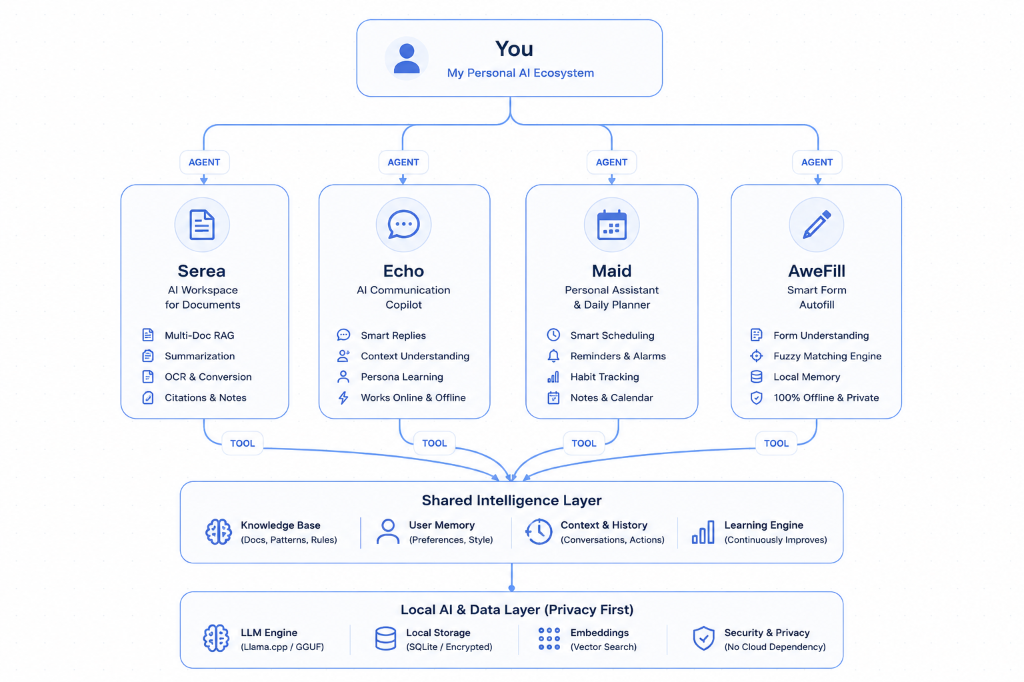
A document workspace became Serea. A repetitive task became an automation. A YouTube downloader became a weekend project. Personal AI assistants replaced manual workflows. Cron jobs handled repetitive work. Small utilities slowly grew into products I used every day.
Instead of depending on dozens of separate applications, I found myself creating software designed specifically for the way I work. That completely changed my perspective. Today, I don't build projects simply to learn a technology—I build tools because I genuinely want to use them.
Looking Back
Looking back, I don't think I chose AI because it was the next trend. I chose it because it challenged the way I thought about software.
Web development taught me how to build applications. Artificial Intelligence taught me how to build systems that can learn, assist, and adapt.
Today, my work combines both worlds. I still enjoy designing great software and full-stack development, but what excites me most is building intelligent products that solve real problems.And I have a feeling that this is only the beginning.